
How My Visual Language Was Born
My visual language was born out of a quest. Long before I found my own voice, I sought to understand the great questions that have accompanied humankind since time immemorial. Classical mythology became the first path through which I transformed those questions into images.
When My Quest Began
Art has the power to speak to things that cannot always be explained in words. Rather than simply depicting scenes or characters, I felt the need to explore questions that have accompanied humanity since ancient times: who we are, where we come from, and what our place is in the universe. Those questions were the starting point for my painting long before the first symbols appeared.
Classical mythology became the first language through which I began to give shape to those questions. Its characters did not merely represent stories from the past; for me, they were a way to reflect on knowledge, time, freedom, and the search for meaning. Little by little, I began reinterpreting those stories to create my own compositions, in which each element began to take on meaning within the work. Without realizing it, the first symbols began to appear in those watercolors. I didn’t choose them; they emerged naturally, and over the years, I came to understand that they were already shaping the visual language that defines my work today.
The Need for Answers
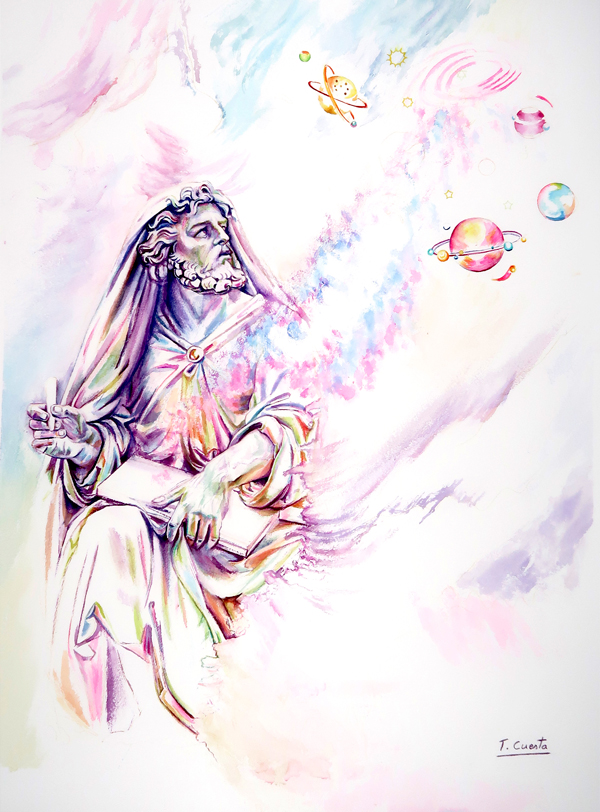
“Knowledge of the Universe” represents the origin of my visual language. The figure gazes toward the sky, trying to understand what has always intrigued humankind: who we are, where we come from, what the meaning of our lives is, or why we are here. These are questions that have accompanied me since I was very young and that awakened in me the need to seek answers through painting.
When I look at this watercolor today, I discover something that I probably wasn’t fully aware I had painted myself. The figure isn’t just observing the universe: little by little, she begins to merge with it. Her body dissolves and becomes part of the sky, as if the answer to that quest weren’t outside us, but rather in understanding that we, too, are part of the universe we’re trying to comprehend. I never set out to find a definitive answer. What interested me was using art to explore those questions and transform them into images.
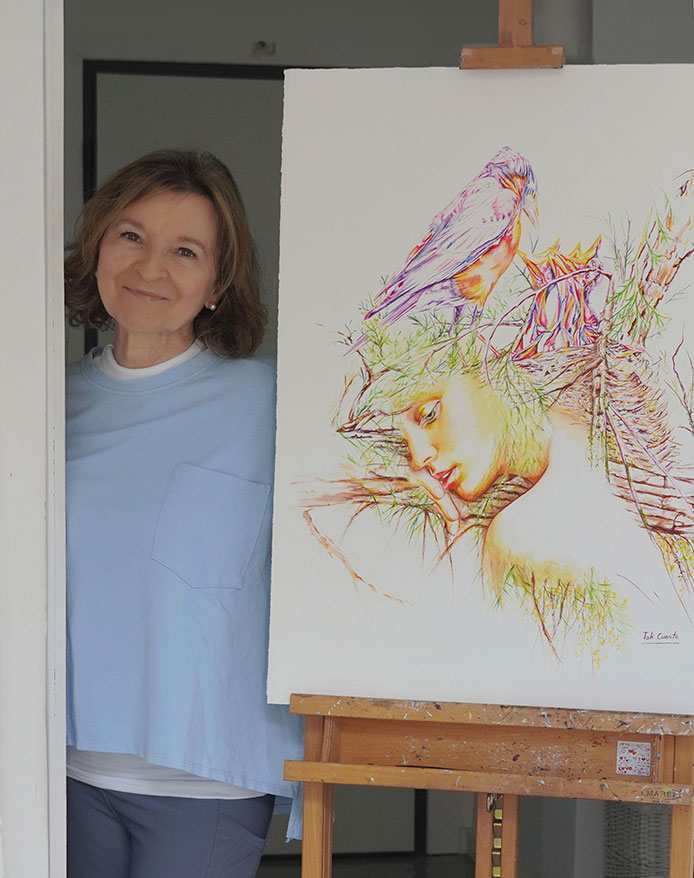
About Me
From a very young age, I felt the need to use painting to explore questions that had always been with me: who we are, where we come from, and what our place is in the world. Before finding my own visual language, I embarked on a journey of discovery in which classical mythology became the first medium for transforming those concerns into images.
Over the years, I came to understand that those early watercolors already contained the origins of my work. Symbols began to emerge naturally and started to build a language that would continue to evolve into the symbolic compositions and visionary art I create today.
Every stage of my career is part of that same journey. Looking at these works today has allowed me to discover that the questions have never changed; what has evolved is the way I express them through painting.
Mythology as a Language of Its Own
Beyond the Classical Tales
I’ve always been fascinated by classical mythology because I discovered that its stories continued to raise the same questions that have accompanied humankind for centuries. I didn’t see the gods as distant figures from the past, but rather as symbols capable of expressing concerns that remain fully relevant today. That’s why I never felt the need to faithfully illustrate the classical myths. Very soon, I began to reinterpret them and create my own stories.
Each watercolor became a new narrative. The characters retained their symbolic power, but they no longer represented only the original story; instead, they became part of compositions I created myself. Mythology ceased to be merely a subject and became the first language through which I began to express my own inner world.
Returning Home
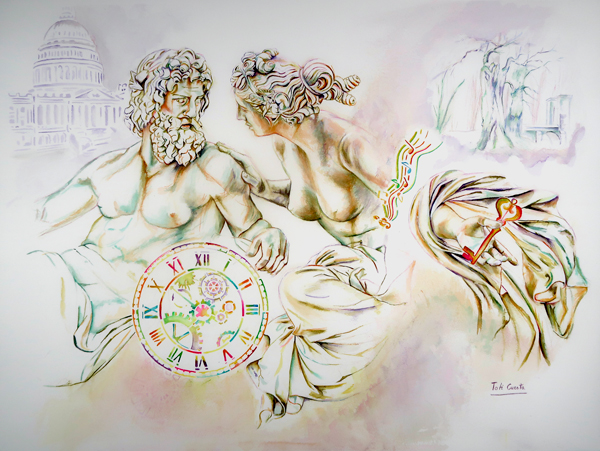
Let’s Go Home began as a metaphor for personal transformation. There are moments when we feel that the time has come to leave a stage of our lives behind and return to ourselves. It’s not about returning to a physical place but about rediscovering who we are when we stop living guided by fear, expectations, or habit.
In this watercolor, the female figure tries to convince the male figure that the moment has arrived. The story does not belong to any classical tale; it arises from a reflection on the need to let go of what no longer makes sense in order to embark on the journey back to our own inner selves. It was in works like this one that mythology began to become a language through which to express deeply human experiences.
“It’s not about returning to a physical place, but about returning to oneself.”
The symbols began to tell their own stories.
The Birth of a Symbolic Language
Over time, the mythological scenes became increasingly personal. I no longer needed the entire narrative to rest on the characters. Little by little, objects and small details began to appear, adding new meanings to the composition. Books, manuscripts, clocks, and fragments of text ceased to be mere decorative elements and became part of the story.
That was when I realized that my visual language was beginning to transform. Each symbol added a new layer of interpretation, and the work ceased to depend solely on the scene depicted. Without consciously seeking it, those elements began to shape a different way of telling stories, foreshadowing the evolution that would unfold in my painting years later.
When Inspiration Fades
Erato Absent was conceived with those moments in mind when, even though our body remains here, our mind is far away. These are the moments when we continue to look at the paper, a book, or the landscape before us, yet we feel that whatever was driving us to create has vanished. Inspiration seems to have departed, and all that remains is waiting.
Erato is the muse of poetry in Greek mythology, but in this watercolor I wanted to imagine her from another perspective: that of her absence. It does not represent inspiration when it arrives, but rather the void it leaves when it departs. It was one of the first times I used a mythological figure to speak of a deeply human and everyday experience, transforming a classical myth into a story of my own.
The Value of Leaving Behind the Familiar
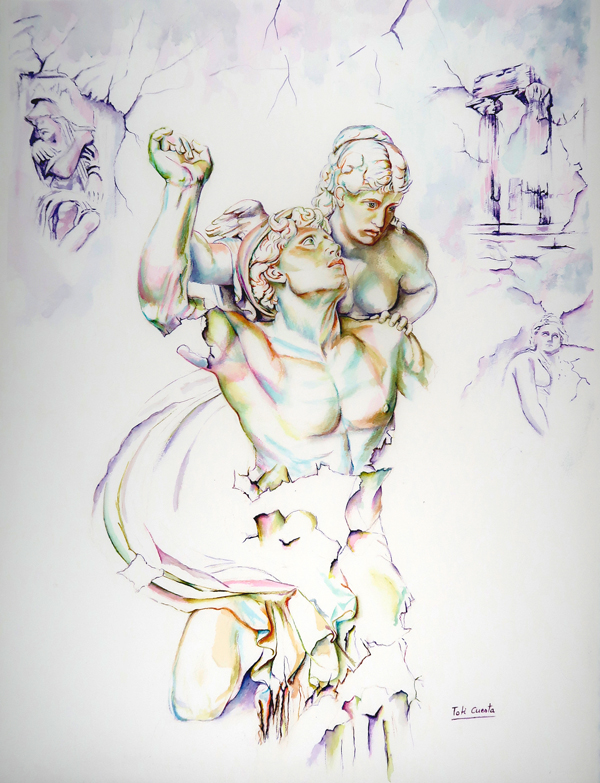
In this work, I imagined a female figure and a male figure who decide to leave Mount Olympus. For me, this symbolizes those moments when we feel the time has come to leave behind a life that no longer represents us, even if doing so means facing uncertainty. Sometimes we remain in places that offer us security but no longer make sense. Taking the leap into the unknown is frightening, but it can also be the beginning of a new chapter.
The male figure appears to be fragmenting as he leaves that seemingly perfect world. He doesn’t know what he’ll find on the other side, but he understands that staying where he is is no longer an option. Looking at this watercolor today, I realize that I was no longer using mythology to tell stories of the past, but rather to express deeply human experiences that would form part of the birth of my visual language.
“Every transformation begins when we dare to leave behind what no longer makes sense.”
A Constantly Evolving Visual Language
Those early symbolic watercolors marked the beginning of a journey that continues to evolve today. Mythology was the first language I used to express the questions that had always accompanied me. Over time, new symbols, new images, and new ways of representing those same concerns emerged naturally, giving rise to the visual language that defines my work today.
Each stage of that evolution has been part of the same quest. The questions that gave rise to my painting have not changed; what has evolved is the way I express them. That journey remains open and continues to grow with each new watercolor.
Discover other stages of my work.
Nature began to form part of my visual language.
→ Contemporary Female Portrait
Identity and emotion through portraiture.
→ Landscape and Portrait in Watercolor
When the human figure begins to merge with nature.